Comprehensible Input Explained: What Krashen Got Right and Wrong
Comprehensible input is language you understand, a little above your level. What Krashen claimed, what 40 years of research support, and what he got wrong.

In short: Comprehensible input is language you can understand, even though it contains a little you don't know yet. Stephen Krashen argued in the early 1980s that understanding lots of it is how we acquire a language. Four decades later, that core idea has held up well: every major theory of how people learn languages gives input a central role, and reading and listening programs have a good track record. What has not held up is the idea that input is all you need. Speaking, writing and some attention to grammar add things that input alone does not.
What comprehensible input means
Imagine you are learning Spanish and someone says Mi hermana vive en Lisboa, cerca del río. You know hermana (sister) and vive (lives), you can guess Lisboa, and cerca del río is new. But the rest of the sentence, the situation and maybe a gesture toward a map tell you it means "near the river". You understood the message, and on the way you met something new. That is comprehensible input.
The term comes from the linguist Stephen Krashen. In his 1982 book Principles and Practice in Second Language Acquisition, he put it in four parts:
- Input drives acquisition, the unconscious process that gives you fluent language, as opposed to learning, the conscious study of rules.
- We acquire by understanding language that contains structure "a little beyond" our current level. He wrote this as i + 1: i is where you are now, +1 is the next step. Context and what you know about the world fill the gap.
- You don't need to aim at i + 1 on purpose. If you understand the input and there is enough of it, the next step will be in there automatically.
- Speaking "emerges" on its own. It is not taught directly.
Two details are often lost in retellings. First, Krashen called understanding i + 1 "a necessary (but not sufficient) condition". The other ingredient, in his theory, was the learner's emotional state, which he called the affective filter: an anxious or unmotivated learner may understand the input and still not take it in. Second, "understand" meant focusing on the meaning of a message, not on its grammar.
Krashen's theory had five hypotheses in all. This article focuses on the input hypothesis, because that is what people mean when they say "comprehensible input".
What Krashen got right
The most useful summary of where things stand comes from a 2021 essay by Karen Lichtman and Bill VanPatten, "Was Krashen right? Forty years later", in Foreign Language Annals. Their verdict on the input hypothesis is mostly yes, with the edges trimmed.
They point out that Krashen's theory was widely criticized and dismissed, but that the field gradually came back to the core of the input hypothesis. Today, all the major theories of second language acquisition, from Universal Grammar to usage based and cognitive models, treat input as the main raw material of learning. They disagree about what learners take from it, not about whether it matters. The authors propose a simpler, updated version of the hypothesis: "The principal data for the acquisition of language is found in the communicatively embedded comprehensible input that learners receive. Comprehension precedes production in the acquisition process."
The practical evidence points the same way. Reading and listening programs, where learners take in large amounts of language they understand, have been tested many times:
- The Fiji book flood. Warwick Elley and Francis Mangubhai (1983) gave classes in eight rural Fijian schools 250 illustrated storybooks in English each. After eight months, the 380 pupils in Classes 4 and 5 who read the books progressed in reading and listening comprehension at twice the normal rate, compared with 234 pupils in the usual structured English program. After 20 months the gains had grown and spread to related skills.
- Two meta-analyses of extensive reading. A meta-analysis pools many studies to see whether an effect holds overall. Nakanishi (2015) combined 34 studies with 3,942 participants and found a medium effect (d = 0.46) when readers were compared with control groups. Jeon and Day (2016) pooled 49 studies with 5,919 participants and found small to medium effects on reading proficiency, larger for adults than for children and teenagers.
- Six years of input only. In New Brunswick, Canada, Patsy Lightbown and colleagues followed children who learned English through a program based essentially on reading and listening. In grades 4 and 5 they did as well as or better than children taught with traditional audio-lingual drills on most measures. By grade 8, after six years, they still matched the comparison groups in comprehension and some measures of speaking (Lightbown, Halter, White and Horst, 2002).
How sure are we? Fairly sure about the core. Across countries, ages and methods, people who understand a lot of a language get better at it, and current theories agree that input is the main source of what learners know. The disagreement is about whether it is the only thing that matters.
What Krashen got wrong, or too strong
The criticisms fall into three groups.
1. "i + 1" can't be measured
Krashen never defined i. Was it your place in a sequence of grammar structures? A general level? Lichtman and VanPatten, who are sympathetic to Krashen, agree with the critics here: since i has no scale, +1 has none either, and "we have no idea how to measure '+ 1'". A claim you cannot measure is a claim you cannot test, and this is the main reason many researchers set the whole hypothesis aside.
Some later research gives a workable stand in. Vocabulary studies suggest readers learn best when they know about 95 to 98 percent of the words in a text, and Lichtman and VanPatten note that this could be read as a version of the +1: no more than about 5 percent unknown words. Our article on learning a language by reading covers that research.
2. Understanding is not the same as acquiring
If comprehension drives acquisition, making input easier to understand should make learners acquire more. Lester Loschky (1994) tested this with learners of Japanese. One group got unmodified input, one got input simplified in advance, and one could ask questions and negotiate the meaning as they went. The negotiating group understood the most at the moment. But how much learners understood did not predict how much vocabulary and grammar they learned. All three groups made gains.
Comprehension seems to be a condition for learning, not a measure of it. Understanding a message, you can skip right over the grammar that carries it, because context already told you what it means.
3. Output and attention matter too
This is the biggest change since the 1980s, and it comes from three lines of research.
Output. Merrill Swain's output hypothesis argues that speaking and writing make you notice the gap between what you want to say and what you can say. In a study of learners thinking aloud while writing, Swain and Sharon Lapkin (1995) found that problems in producing the language sometimes made learners notice them, rethink and change what they wrote, processing the grammar more closely than comprehension requires. Note how modest the claim is: output helps "sometimes, under some conditions", as Lichtman and VanPatten quote it. The New Brunswick children point the same way: after six years of input, they matched their peers in understanding, but not in writing (Lightbown and colleagues, 2002).
Noticing. The noticing hypothesis, proposed by the linguist Richard Schmidt, says that learners must consciously notice something in the input before it can become part of what they learn. As Lichtman and VanPatten point out, it doesn't reject input. It adds that what you attend to matters, not only what you hear or read.
Instruction. Krashen argued that consciously learned rules play only a small role. Meta-analyses disagree. Norris and Ortega (2000) combined 49 studies and found that focused instruction produces large gains, that explicit teaching (explaining the rule) tends to beat implicit teaching, and that the gains last. Spada and Tomita (2010), pooling 41 studies, found larger effects for explicit instruction for both simple and complex grammar, including in spontaneous use, not only on tests.
Input or output? What the head to head studies show
So should learners mostly listen and read, or mostly speak and write? Natsuko Shintani, Shaofeng Li and Rod Ellis (2013) pooled 35 studies, from 30 published papers, that compared the two directly. Both kinds of instruction had large effects. For understanding, input based teaching did better at first, but the difference faded on tests a week to 75 days later. For producing the language, the two were equal at first, and output based teaching did better on the later tests.
That is roughly the balanced view most researchers hold today. Input is the foundation: you cannot say what you have never heard or read. But you produce language well partly by producing it, and a little attention to form helps you notice what input alone lets you skip.
Where the research stands now
Here is the fair summary, in plain terms:
- Right: Understanding lots of language is the main engine of acquisition. Learners need large amounts of it, and it has to be at a level they can follow. Every major theory now agrees.
- Right: Comprehension comes before production. You understand a structure before you can use it, so it is normal to understand more than you can say.
- Too strong: Input is not the only thing that matters. Output helps, especially for accuracy in speaking and writing, and explicit instruction has measurable, lasting effects.
- Untestable: i + 1 as Krashen defined it can't be measured. The idea behind it, that input should be mostly known with a little new, survives in measurable forms like vocabulary coverage.
Lichtman and VanPatten compare the theory to the early model of the atom: the details were revised, but the core is still there.
How to use comprehensible input today
- Find material you mostly understand. Aim to know 95 to 98 percent of the words: one or two new ones in a paragraph, not one in every sentence. If it's harder than that, drop down a level.
- Get a lot of it. The input studies that worked ran for months, not days. Make reading or listening a daily habit, and do more when you enjoy it.
- Pick things you want to understand. Krashen thought anxiety and low motivation block input. Whatever the mechanism, stories you care about keep you reading, and volume is what drives results.
- Notice one thing. After a passage, pick a phrase that surprised you (a word order, an ending) and look at it closely. Noticing is what turns input into something you learn.
- Produce a little. Retell what you read in two or three sentences, or write a short message. Then compare with how a fluent speaker would say it. That gap is where the output research says you learn.
- Use grammar as a map, not the road. A short explanation of a pattern you keep seeing makes it easier to notice the next time you meet it.
- Come back to words. New words need several encounters to stick, so staying at one level for a while helps. Our article on how many times you need to see a word explains why.
Where Franzie fits in
We built Franzie on this balance. Its stories are written at your level, about genres you choose, so most of what you read is input you understand, with a little that is new. You can listen while you read, and tap any word or sentence for its meaning and grammar when you want to notice something.

After each chapter, short exercises ask you to use what you read: write a message, answer a question, talk with a character in a roleplay. You get feedback that shows a better way to say it, which is exactly the gap noticing the output research describes.
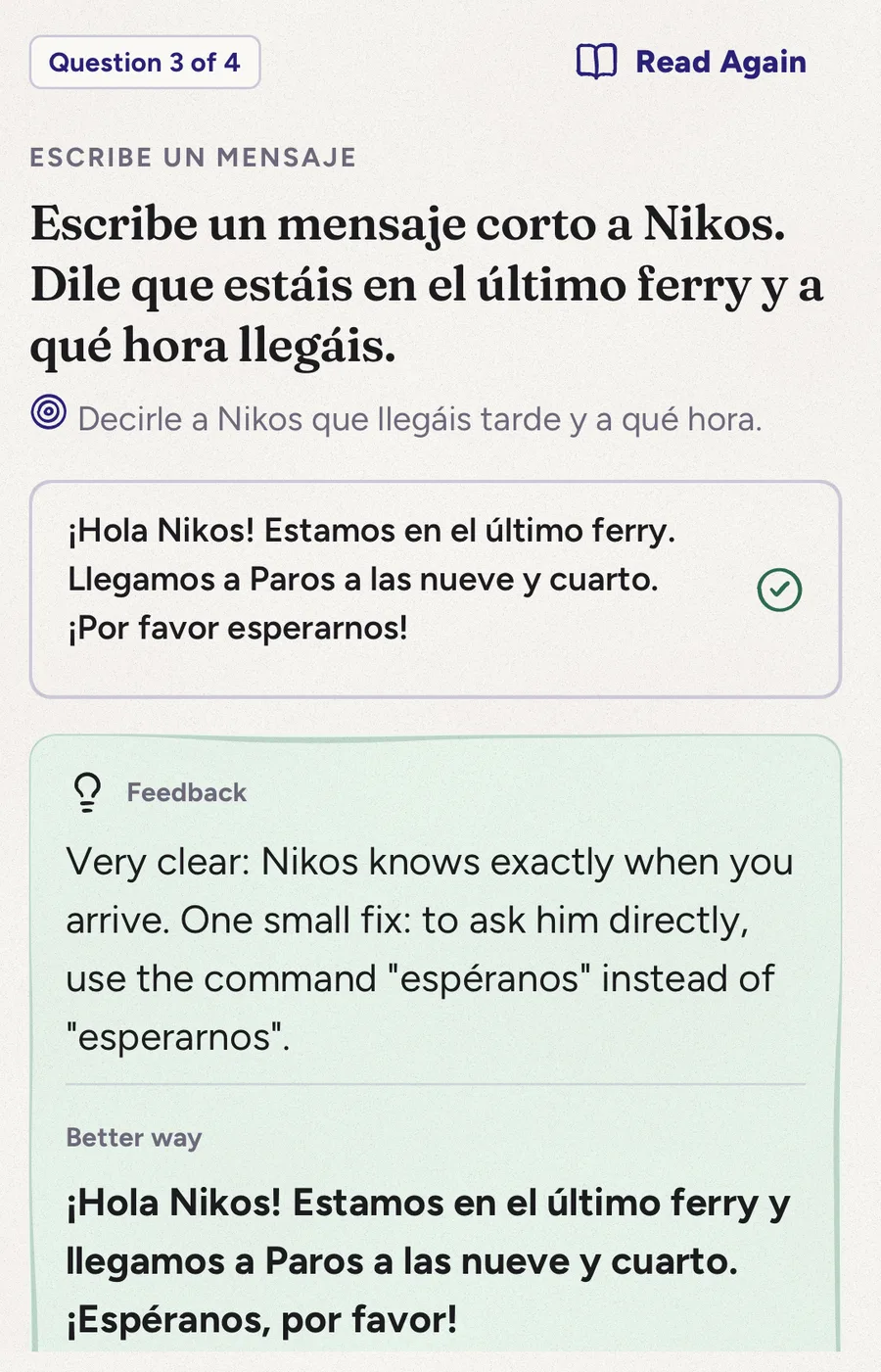
You can follow the same plan without an app: graded readers, podcasts for learners, a notebook, and someone to write to.
FAQ
What is comprehensible input?
Language you can understand, from context and what you already know, even though it contains some words or structures you have not learned yet. The term comes from Stephen Krashen's input hypothesis.
Is Krashen's input hypothesis still accepted?
Its core is. Current theories agree that input is the main source of language learning. Its strongest claims are not: most researchers think output and some explicit instruction also help, and i + 1 has never been measurable.
Can you learn a language only with comprehensible input?
You can get far, especially in understanding. A Canadian study of children who learned English mostly through reading and listening for six years found they matched their peers in comprehension but not in writing. To speak and write well, practice those skills too.
What does i + 1 mean?
In Krashen's theory, i is your current level and i + 1 is language just beyond it. In practice, it means material you mostly understand, with a little that is new.
How do I find comprehensible input at my level?
Look for graded readers, stories and podcasts for learners. If you can follow the story and meet only one or two unknown words per paragraph, the level is right.
Sources
- Elley, W. B., & Mangubhai, F. (1983). The impact of reading on second language learning. Reading Research Quarterly, 19(1), 53 to 67. https://doi.org/10.2307/747337
- Jeon, E. Y., & Day, R. R. (2016). The effectiveness of ER on reading proficiency: A meta-analysis. Reading in a Foreign Language, 28(2), 246 to 265. https://doi.org/10.64152/10125/66901
- Krashen, S. (1982). Principles and Practice in Second Language Acquisition. Pergamon. http://www.sdkrashen.com/content/books/principles_and_practice.pdf
- Lichtman, K., & VanPatten, B. (2021). Was Krashen right? Forty years later. Foreign Language Annals, 54(2), 283 to 305. https://doi.org/10.1111/flan.12552
- Lightbown, P. M., Halter, R. H., White, J. L., & Horst, M. (2002). Comprehension-based learning: The limits of "do it yourself". The Canadian Modern Language Review, 58(3), 427 to 464. https://doi.org/10.3138/cmlr.58.3.427
- Loschky, L. (1994). Comprehensible input and second language acquisition: What is the relationship? Studies in Second Language Acquisition, 16(3), 303 to 323. https://doi.org/10.1017/s0272263100013103
- Nakanishi, T. (2015). A meta-analysis of extensive reading research. TESOL Quarterly, 49(1), 6 to 37. https://doi.org/10.1002/tesq.157
- Norris, J. M., & Ortega, L. (2000). Effectiveness of L2 instruction: A research synthesis and quantitative meta-analysis. Language Learning, 50(3), 417 to 528. https://doi.org/10.1111/0023-8333.00136
- Shintani, N., Li, S., & Ellis, R. (2013). Comprehension-based versus production-based grammar instruction: A meta-analysis of comparative studies. Language Learning, 63(2), 296 to 329. https://doi.org/10.1111/lang.12001
- Spada, N., & Tomita, Y. (2010). Interactions between type of instruction and type of language feature: A meta-analysis. Language Learning, 60(2), 263 to 308. https://doi.org/10.1111/j.1467-9922.2010.00562.x
- Swain, M., & Lapkin, S. (1995). Problems in output and the cognitive processes they generate: A step towards second language learning. Applied Linguistics, 16(3), 371 to 391. https://doi.org/10.1093/applin/16.3.371
Keep reading
-
 Reading
How to Learn a Language by Reading: What the Research Says
Can you learn a language just by reading? What decades of research say about how much of a text you need to understand, how often you need to see a word, and how to read for real progress.
Read the article
-
 Guides
How Long Does It Take to Learn French? What the Research Says
About 600 class hours for full time diplomats, and longer for most of us. What the FSI figures say about French, why listening is the slow part, and what helps.
Read the article
-
 Memory
How Many Times Do You Need to See a Word to Learn It?
Research says about 10 encounters for a solid start, and some words take more than 20. Why the number varies, and how to make each encounter count.
Read the article