How Many Times Do You Need to See a Word to Learn It?
Research says about 10 encounters for a solid start, and some words take more than 20. Why the number varies, and how to make each encounter count.
In short: There is no single magic number, but research gives a useful range. When you pick up words from reading, about 10 encounters is where learning becomes likely: in one study, readers recognized the meaning of 84 percent of the words they met 10 times or more. Below about eight encounters, most new words are forgotten within months, and some words still slip away after 20. How you meet a word matters as much as how often: spread the encounters out, see the word in different sentences, and try to recall it, not just reread it.
The short answer: about 10, and sometimes many more
If you want one number to remember, make it 10. Across several studies of learners who meet new words while reading, something changes at around ten encounters: words seen that often are much more likely to be understood, recognized and remembered than words seen only a few times.
But "10" comes with three honest caveats:
- It depends on what "learn" means. Recognizing a word's meaning when you see it comes first. Recalling it yourself, spelling it and using it correctly in a sentence come later and need more encounters.
- Some words are harder than others. Even after 20 encounters, some words do not stick.
- Not all encounters are equal. A word you meet once a day for ten days is not the same as a word you meet ten times in one afternoon.
That is why you will see answers online ranging from 6 to 20 and beyond. They are not contradicting each other. They are measuring different things.
What the studies found
Researchers usually study this by giving learners a text where certain unknown words appear a set number of times, then testing what they learned. Here are the main findings, from the most controlled to the most realistic.
Webb (2007): 1, 3, 7 and 10 encounters. Stuart Webb had 121 Japanese students of English read short contexts in which new words appeared 1, 3, 7 or 10 times, then gave them ten different tests: spelling, meaning, grammar, word associations and more. Each step up in encounters improved at least one kind of knowledge. His conclusion: ten encounters in context can bring sizeable gains, but full knowledge of a word may take more than ten.
Rott (1999): even two encounters count. Susanne Rott had intermediate learners meet unfamiliar words two, four or six times while reading. Just two encounters already made a measurable difference, two and four gave similar results, and six gave significantly more. So learning starts early, it just doesn't finish early.
Pellicer-Sánchez and Schmitt (2010): a real novel. Twenty advanced Spanish learners of English read Things Fall Apart, an unmodified novel that includes 34 Igbo words they could not have known. For words met 10 or more times, they recognized the meaning of 84 percent and could recall the meaning of 55 percent. For words met 8 times or fewer, those figures were 36 and 7 percent. The authors found the clearest dividing line between 5 to 8 encounters and 10 or more.
Pigada and Schmitt (2006): one learner, one month of reading. In a case study, one learner of French read four graded readers in a month and was interviewed about 133 target words. Knowledge of 65 percent of them improved in some way. Spelling improved even after a few encounters, but meaning took longer: there was no point where meaning was guaranteed, though learning rose noticeably from about 10 encounters. Some words, like essayer (to try), were still not learned after 10 or more encounters, and le radeau (raft) not even after 20.
Waring and Takaki (2003): what is left three months later. Fifteen Japanese learners at intermediate level or above read a graded reader in which 25 target words appeared between once and 15 to 18 times. Three months later, on average, they remembered the meaning of only one of the 25 words, and none of the words they had met fewer than eight times.
How sure are we? Fairly sure about the direction, less about the exact number. A meta-analysis (a study that pools the results of many studies) by Uchihara, Webb and Yanagisawa (2019) combined 26 studies with 1,918 learners and found a medium sized link between the number of encounters and learning. The size of that link varied with the learner (age, how many words they already knew), with how the words were met (spacing, pictures, how engaged learners were) and with how they were tested. More encounters help, reliably. How many you need depends on all of these.
Why the answer ranges from 6 to 20
If you read five articles on this question, you may get five numbers. Here is why.
Recognition is easier than recall. Picking the right meaning from a list (recognition) is much easier than producing the word or its meaning from memory (recall). In the novel study above, after 10 or more encounters, learners recognized 84 percent of the meanings but recalled only 55 percent. So a study that tests recognition will suggest fewer encounters than one that tests recall or use.
Tested today or in three months? Many studies test learners right after reading. Waring and Takaki tested again after three months, and very little was left. A word you knew yesterday is not a word you have learned.
Words differ. A word that looks like one in your own language, names something concrete, or matters to the story is easier. A short, common verb with many meanings can be surprisingly slippery, as Pigada and Schmitt's essayer shows.
Learners differ. The 2019 meta-analysis found that learners' age and the number of words they already knew both changed how much repetition helped. The same number of encounters does not do the same for everyone.
Reading alone is slow. A 2023 meta-analysis by Webb, Uchihara and Yanagisawa pooled 24 studies with 2,771 participants who learned words just from reading, listening or watching. On average, learners picked up 9 to 18 percent of the target words on the first test, and on later tests the authors estimate fewer than 20 percent. Deliberate study (flashcards, exercises) does better: the authors cite an earlier meta-analysis where learners kept 39.4 percent. Reading gives you volume; deliberate review makes sure the important words stick.
What makes an encounter count
Ten encounters is a rough guide. Ten good encounters is a better one. The research points to three things that make each one worth more.
1. Space the encounters out
Meeting a word ten times in one sitting is less useful than meeting it on ten different days. In the 2023 meta-analysis, learning from input was larger when encounters were spread over several sessions than when they all happened in one, and the gap grew on delayed tests (an effect size of 1.71 for spaced learning against 0.58 for massed learning).
The same holds for flashcards. Nate Kornell (2009) had learners study word pairs either in one large stack (so each card came back after a longer gap) or in several small stacks (shorter gaps). The large stack won for 90 percent of participants. Yet after the first session, 72 percent believed the small stacks had worked better. Spacing feels harder, which is exactly why it works. Our post on spaced repetition explains this in more detail.
2. Try to recall, don't just reread
Seeing a word is one kind of encounter. Pulling it from memory is a stronger one. Tatsuya Nakata (2017) had 98 Japanese learners study 16 English words, each retrieved from memory one, three, five or seven times in a single session. Five and seven retrievals led to clearly better scores than one or three, even weeks later. There is a twist: per minute spent, one retrieval was the most efficient. So repeated recall pays off, but spreading those recalls over several days beats piling them into one session.
3. Meet the word in different sentences
Every encounter in a new sentence teaches you something extra: another meaning, a word it often goes with, how it behaves in grammar. This is why the novel study counted spelling, word class and meaning separately: each one grows at its own pace.
Detrás del mostrador hay una carta y una llave pequeña.
Lucía guarda la llave en su bolsillo.
Por la noche, la llave no abre la puerta de la librería.
How much reading is that?
If about 12 encounters per word is the goal, how much do you need to read to get them? Paul Nation (2014) answered this with large collections of English text, using 12 encounters as a "moderately safe" target.
His estimates: to meet the words of the 2,000 most frequent word families around 12 times, you need about 200,000 words of reading. For the 9,000 most frequent, about 3 million, or roughly two to twenty five novels depending on your level. (A word family is a word plus its forms, like read, reads, reading, reader.)
That sounds like a lot, but Nation turns it into time. Reading at 150 words a minute, five days a week, learning the third thousand words takes about 10 minutes a day; the fifth thousand, about 33 minutes a day. The catch is that the text has to be at the right level, so these words are the few unknown ones on the page. That is the case for reading lots of easy text, which we cover in how to learn a language by reading.
A practical plan for your next 100 words
You can use all of this today, with or without an app.
- Read every day at a comfortable level. Choose texts where you know almost every word, so the new ones stand out and you can guess them from context. Volume is what brings words back.
- Stay in one topic or series for a while. A series of books or stories reuses the same characters, places and vocabulary, so the same words keep coming back on their own.
- Save the words that come up twice. A word that appears a second or third time is probably worth learning. Write it down with the sentence you found it in.
- Review by recalling, not by rereading. Cover the meaning and try to remember it, or see the meaning and try to produce the word. Getting it wrong and then checking still helps.
- Spread your reviews. Review a new word the next day, then a few days later, then a week or two later. Short, spaced sessions beat one long one.
- Use the word once. Write it in a sentence about your day or say it out loud. Using a word is another kind of encounter, and it shows you whether you really know it.
- Don't worry about the stubborn ones. If a word still won't stick after many encounters, that is normal. Keep reading; it will come back.
Where Franzie fits in
We built Franzie so that the encounters add up without extra effort. It writes stories in your target language at your level, and the stories continue chapter after chapter, so the same characters and words come back. Tap any word to see its meaning and grammar and hear it, then save it.
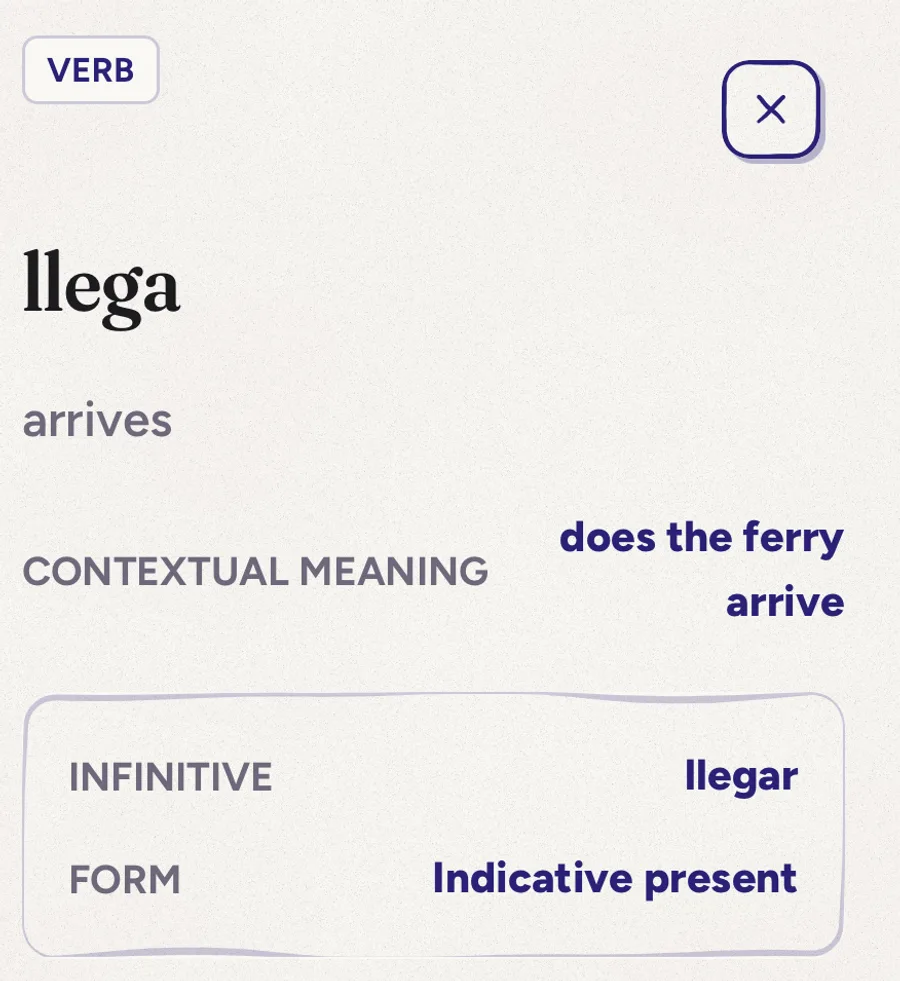
Saved words come back in your vocabulary reviews, where you see the meaning and recall the word, at growing intervals. They also come back in your next stories where they fit, so you meet them again in a new sentence, not just on a card. That is spacing, recall and varied context, in one routine.
You don't need an app to do this, though. A stack of graded readers, a notebook and a few minutes of review each day follow the same principles.
FAQ
How many times do you need to see a word to remember it?
Research suggests around 10 encounters while reading for a good chance of recognizing its meaning, and more to recall and use it. In one study, words met fewer than eight times were not remembered three months later.
Is the "7 times" rule true?
No study shows that seven is a fixed number. Some words are learned in fewer encounters, others need more than 20. What matters is how far apart the encounters are and whether you try to recall the word.
How many new words can I learn a day?
It depends on how much time you have for review. Each new word needs several spaced encounters over the following weeks, so a smaller number you actually review beats a large list you see once.
Is reading enough to learn vocabulary?
Reading builds vocabulary steadily, but slowly: in studies, learners pick up fewer than 20 percent of new words from reading or listening alone. Adding deliberate review of the most useful words makes much more of them stick.
Sources
- Kornell, N. (2009). Optimising learning using flashcards: Spacing is more effective than cramming. Applied Cognitive Psychology, 23(9), 1297 to
- Nakata, T. (2017). Does repeated practice make perfect? The effects of within-session repeated retrieval on second language vocabulary learning. Studies in Second Language Acquisition, 39(4), 653 to 679. https://doi.org/10.1017/S0272263116000280
- Nation, I. S. P. (2014). How much input do you need to learn the most frequent 9,000 words? Reading in a Foreign Language, 26(2), 1 to 16. https://doi.org/10.64152/10125/66881
- Pellicer-Sánchez, A., & Schmitt, N. (2010). Incidental vocabulary acquisition from an authentic novel: Do Things Fall Apart? Reading in a Foreign Language, 22(1), 31 to 55. https://doi.org/10.64152/10125/66652
- Pigada, M., & Schmitt, N. (2006). Vocabulary acquisition from extensive reading: A case study. Reading in a Foreign Language, 18(1), 1 to 28. https://doi.org/10.64152/10125/66611
- Rott, S. (1999). The effect of exposure frequency on intermediate language learners' incidental vocabulary acquisition and retention through reading. Studies in Second Language Acquisition, 21(4), 589 to 619. https://doi.org/10.1017/S0272263199004039
- Uchihara, T., Webb, S., & Yanagisawa, A. (2019). The effects of repetition on incidental vocabulary learning: A meta-analysis of correlational studies. Language Learning, 69(3), 559 to 599. https://doi.org/10.1111/lang.12343
- Waring, R., & Takaki, M. (2003). At what rate do learners learn and retain new vocabulary from reading a graded reader? Reading in a Foreign Language, 15(2), 130 to 163. https://doi.org/10.64152/10125/66776
- Webb, S. (2007). The effects of repetition on vocabulary knowledge. Applied Linguistics, 28(1), 46 to 65. https://doi.org/10.1093/applin/aml048
- Webb, S., Uchihara, T., & Yanagisawa, A. (2023). How effective is second language incidental vocabulary learning? A meta-analysis. Language Teaching, 56(2), 161 to 180. https://doi.org/10.1017/S0261444822000507
Keep reading
-
 Memory
Spaced Repetition: The Science, and How to Actually Use It
Spaced repetition works: reviewing words at growing intervals beats cramming in study after study. What the research says, and how to use it without burning out.
Read the article
-
 Guides
How Long Does It Take to Learn French? What the Research Says
About 600 class hours for full time diplomats, and longer for most of us. What the FSI figures say about French, why listening is the slow part, and what helps.
Read the article
-
 Guides
How Long Does It Take to Learn German? What the Research Says
About 600 class hours for full time diplomats, and longer for most of us. What the FSI figures say about German, where the time goes, and what speeds you up.
Read the article