How Long Does It Take to Learn French? What the Research Says
About 600 class hours for full time diplomats, and longer for most of us. What the FSI figures say about French, why listening is the slow part, and what helps.
In short: In the table the US Foreign Service Institute published in 2001, French is one of the easier languages for English speakers: 23 to 24 weeks, or 575 to 600 class hours, to reach a professional level. Those students study full time, add hours of homework a day and are chosen for their gift for languages. Counting the homework, plan on roughly 950 hours of focused work for a high level: about five years at 30 minutes a day, a bit over one at two hours a day. Reading usually comes fastest. Listening and pronunciation are the slow part, and they need their own practice.
The short answer, and why you see different numbers
Search this question and you will find confident numbers ("six months!") next to a lot of "it depends". The best known number comes from the Foreign Service Institute (FSI), the school that trains US diplomats, and it is worth reading closely.
Two of its staff, Frederick Jackson and Marsha Kaplan, published the school's learning expectations in 2001. In their table, French is in Category I, the languages "closely cognate with English", together with German, Italian, Portuguese, Romanian, Spanish, Swedish, Dutch, Norwegian and Afrikaans. For these languages FSI expects students to reach its goal in 23 to 24 weeks, or 575 to 600 class hours. Category II languages, such as Russian, Greek or Turkish, take 44 weeks, and Category III (Arabic, Chinese, Japanese and Korean) 88 weeks.
That is good news for French. But three details change what the number means:
- The goal is high. FSI aims for "general professional proficiency" in speaking and reading, including listening in conversation. Jackson and Kaplan say it is roughly equal to "superior" on the scale of the American Council on the Teaching of Foreign Languages (ACTFL), the top of the scale most US schools use.
- The hours are only class hours. FSI says learning quickly takes at least four class hours a day, five days a week, plus three or more hours a day of independent study.
- The students are unusual. The table assumes a native English speaker with "very good or better aptitude" for classroom language learning, and notes that less skilled learners typically take longer. FSI's students are adults (their mean age was 41) who already knew, on average, 2.3 other languages.
So 600 hours is not how long French takes. It is how long French takes for gifted, experienced learners studying full time, before you count their homework.
Is French easier than Spanish?
Many people assume Spanish is the easiest language for English speakers. FSI's own records suggest French is at least as easy to reach a given level in.
The economists Barry Chiswick and Paul Miller (2005) used FSI scores of English-speaking Americans of average ability, measured after 24 weeks of training, to build a scale of how hard each language is to learn. On that scale, 1.00 is the hardest (Japanese) and 3.00 the easiest (Afrikaans, Norwegian, Romanian and Swedish).
French scored 2.50, the same as Italian and Portuguese. Spanish and German scored 2.25, and Dutch 2.75. In other words, after the same 24 weeks, average learners of French scored a little higher than learners of Spanish.
There is a reason English speakers get a head start. After the Norman conquest, English borrowed a great many French words, so a page of French is full of words you can guess: la question, possible, le restaurant, important, la nation. That is why reading often feels easy early on. What the page doesn't tell you is how those words sound, and that is where the time goes.
How sure are we? The FSI figures are real records from decades of teaching, which is rare and valuable. But they describe one group of learners in one kind of program, and the scale is coarse. Use them to compare languages, not as a promise for your own timeline.
Doing the math for a normal schedule
You can turn the FSI figures into a rough personal estimate, as long as you remember who they describe. Over 24 weeks, three hours a day of independent study, five days a week, adds about 360 hours to the 575 to 600 class hours. That makes roughly 950 hours of focused work to reach a professional level under ideal conditions.
| Daily study, every day | Time to about 950 hours |
|---|---|
| 30 minutes | about 5 years and 2 months |
| 1 hour | about 2 years and 7 months |
| 2 hours | about 1 year and 4 months |
Two honest adjustments:
- Most of us are not FSI students. No hand-picked aptitude, no class of six with a trained teacher. Expect to need more than this, not less.
- Most of us do not need FSI's goal. Ordering in a café, small talk, travel and easy books come long before professional meetings. If that is your goal, a fraction of these hours gets you there.
Jackson and Kaplan add a warning for anyone hoping to squeeze it all into a few weeks. In their experience, the time a beginner needs to reach professional proficiency "cannot be shortened appreciably". FSI tried, and it did not work.
Levels and exams: DELF, DALF and the CEFR
"How long" only makes sense once you say "to do what". In Europe, levels are described with the CEFR (Common European Framework of Reference for Languages): A1 and A2 for basic users, B1 and B2 for independent users, C1 and C2 for proficient users.
France's official French exams follow these levels. The DELF covers A1 to B2 and the DALF covers C1 and C2. Universities, employers and residence applications often ask for a certificate at a given level.
You will also see hour estimates for each level, from schools and course providers. They rarely agree, because they describe different courses with different students and different amounts of homework. We could not find research that pins down hours per level for French, so treat those charts as a rough guide, and expect the steps to get longer as you climb.
The slow part: hearing and saying French
Many learners of French put it the same way: "I can read it, but I can't understand people when they talk." The research helps explain why.
Words run together
In spoken French, words don't stop where they stop on the page. A final consonant that is normally silent can be pronounced and attach to the next word when that word starts with a vowel. This is called liaison: les amis (the friends) sounds like "lay-zah-mee", and vous avez (you have) like "voo-zah-vay". The result is that the syllables you hear don't line up with the words you know.
Annie Tremblay (2011) used eye tracking to study how native English speakers at three levels of French recognized words in recorded speech, including words heard after a liaison consonant. The learners recognized these words without much trouble, but they did it in a different way from native listeners, using a general rule rather than knowledge of each word. The encouraging message: English speakers can learn to split French speech correctly. It takes listening practice, not just reading.
Sounds English doesn't have
French has vowels that English lacks. The best known is the u in tu (you), which sounds different from the ou in tout (all). Mixing them up changes the word: dessus means on top, dessous underneath.
Erika Levy (2009) tested 39 American English speakers in three groups of 13: no French at all, two to four years of French classes, and years of classes plus at least a year of living in a French-speaking country. On a range of French vowel pairs, the classroom group made about as many errors as the group with no French (11 and 13 percent). The immersion group made only 3 percent. Even they, though, still made 12 percent errors on the u and ou pair.
Two lessons follow. Classroom study alone may do little for your ear, and lots of listening to real French does a lot. And some sounds stay hard for a long time, so don't treat a stubborn vowel as a sign you are failing.
Pronunciation can be taught
The good news is that this part responds to practice. Junkyu Lee, Juhyun Jang and Luke Plonsky (2015) pooled 86 studies of pronunciation instruction and found a generally large effect. Interventions that lasted longer, and those that gave learners feedback, worked better.
You don't need a perfect accent. Jackson and Kaplan note that native accent is typically not a practical criterion for success at FSI, "although intelligibility is". Aim to be understood easily, not to pass as Parisian.
Listening can be taught too
Larry Vandergrift and Marzieh Tafaghodtari (2010) followed 106 students in six French as a second language classes for a semester. One group listened to texts while being guided through how to listen: predicting what they would hear, checking their guesses, and working out problems. The other group heard the same texts the same number of times, without that guidance. The guided group understood better at the end, and the weaker listeners in it gained the most.
So "listen more" is good advice, and "listen with a plan" is better.
What speeds it up
Time and intensity
Jackson and Kaplan write that time on task and the intensity of the learning experience "appear crucial", and that FSI's experience shows "unequivocally" that time spent reading, listening and interacting in the language is closely related to how well learners can use it. A summer course or a month of extra evenings moves you more than the same hours spread thin.
Spacing your reviews
Intensity is not the same as cramming. Su Kyung Kim and Stuart Webb (2022) pooled 48 experiments with 3,411 participants and found that spaced practice had a medium to large effect on second language learning, and that longer gaps between sessions worked better on delayed tests. Study a lot when you can, but bring back each word and sound over days and weeks. We explain how in spaced repetition, and how to actually use it.
Reading, with sound
Reading is where English speakers make fast progress in French, and it builds the vocabulary you need to understand speech (more in how to learn a language by reading). The trick for French is to hear what you read. Reading along with audio links the spelling you recognize to the sounds you don't, including the silent letters and the liaisons.
A realistic plan
- Pick a goal you can describe. "Pass the DELF B1" or "chat with my neighbors in Lyon" is better than "be fluent".
- Count hours, not months. A simple log turns "I'm not progressing" into "I've done 120 hours", which is honest and motivating.
- Find a daily minimum you will keep. Thirty minutes every day adds up to over 180 hours a year.
- Listen from day one. Don't wait until your reading is good. Short audio at your level, every day, trains your ear while it is still hard.
- Listen with a plan. Before you play something, guess what you will hear. Afterward, check what you missed and listen again.
- Read with audio. Follow the text while it is read aloud, so spelling and sound grow together.
- Practice the hard sounds on purpose. Pairs like tu and tout, a few minutes at a time, with feedback if you can get it.
Where Franzie fits in
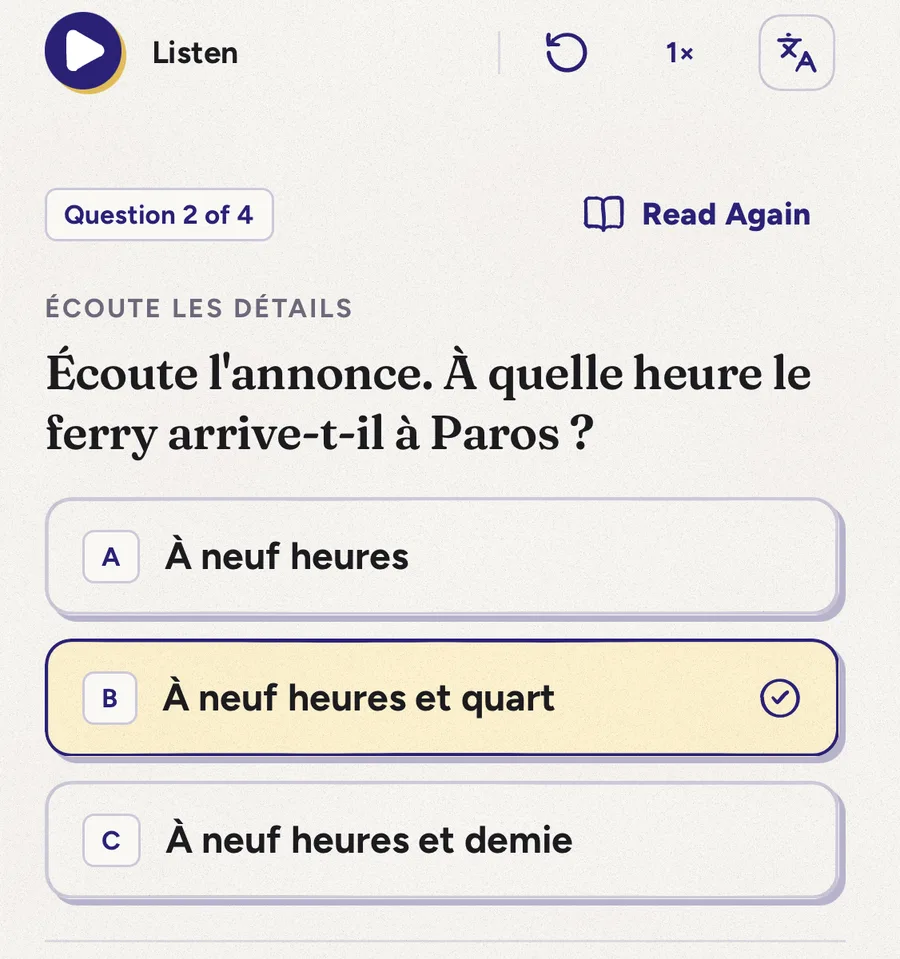
Franzie is one way to make those hours easier to keep. It writes stories in French at your level about topics you choose, and reads each chapter aloud, so you hear every line you read. After a chapter, listening questions about the story train your ear on French you already understand on the page, and a short roleplay lets you use what you heard. You can tap any word for its meaning, save it, and review it later. It is a way to log steady hours, not a shortcut around them.
FAQ
How long does it take to learn French fluently?
For a professional level, the Foreign Service Institute's 2001 table expects 575 to 600 class hours plus daily homework, about 950 hours in total, from very able full time students. Most learners need longer, and most do not need that level to use French comfortably.
Is French harder than Spanish for English speakers?
Not by FSI's records. In scores for learners of average ability after 24 weeks, French scored 2.50 and Spanish 2.25, on a scale where higher means easier. Many learners still find spoken French harder to follow than written French.
Can you learn French in 6 months?
FSI's full time students reach a professional level in 23 to 24 weeks, with at least seven hours of class and study a day. With a normal schedule, six months gives you a base for simple conversations and easy reading.
How long does it take to reach B1 or B2 in French?
There is no research-based number of hours for each CEFR level, and course providers' estimates vary. As a guide, B2 sits below FSI's professional goal, so it takes fewer than FSI's roughly 950 hours, and each level takes longer than the one before.
Why is spoken French so hard to understand?
Words run together through liaison, many written letters are silent, and some vowels don't exist in English. Studies show learners can learn to handle all three, but it takes plenty of listening, not just reading.
Sources
- Chiswick, B. R., & Miller, P. W. (2005). Linguistic distance: A quantitative measure of the distance between English and other languages. Journal of Multilingual and Multicultural Development, 26(1), 1 to 11. https://doi.org/10.1080/14790710508668395
- Jackson, F. H., & Kaplan, M. A. (2001). Lessons learned from fifty years of theory and practice in government language teaching. In J. E. Alatis & A.-H. Tan (Eds.), Georgetown University Round Table on Languages and Linguistics 1999 (pp. 71 to 87). Georgetown University Press.
- Kim, S. K., & Webb, S. (2022). The effects of spaced practice on second language learning: A meta-analysis. Language Learning, 72(1), 269 to 319. https://doi.org/10.1111/lang.12479
- Lee, J., Jang, J., & Plonsky, L. (2015). The effectiveness of second language pronunciation instruction: A meta-analysis. Applied Linguistics, 36(3), 345 to 366. https://doi.org/10.1093/applin/amu040
- Levy, E. S. (2009). On the assimilation-discrimination relationship in American English adults' French vowel learning. The Journal of the Acoustical Society of America, 126(5), 2670 to 2682. https://doi.org/10.1121/1.3224715
- Tremblay, A. (2011). Learning to parse liaison-initial words: An eye-tracking study. Bilingualism: Language and Cognition, 14(3), 257 to
- Vandergrift, L., & Tafaghodtari, M. H. (2010). Teaching L2 learners how to listen does make a difference: An empirical study. Language Learning, 60(2), 470 to 497. https://doi.org/10.1111/j.1467-9922.2009.00559.x
Keep reading
-
 Guides
How Long Does It Take to Learn German? What the Research Says
About 600 class hours for full time diplomats, and longer for most of us. What the FSI figures say about German, where the time goes, and what speeds you up.
Read the article
-
 Guides
How Long Does It Take to Learn Spanish? What the Research Says
About 600 class hours for diplomats training full time, and longer for most of us. What the FSI figures mean, why estimates vary and what speeds you up.
Read the article
-
 Memory
How Many Times Do You Need to See a Word to Learn It?
Research says about 10 encounters for a solid start, and some words take more than 20. Why the number varies, and how to make each encounter count.
Read the article