How Long Does It Take to Learn German? What the Research Says
About 600 class hours for full time diplomats, and longer for most of us. What the FSI figures say about German, where the time goes, and what speeds you up.

In short: In the table the US Foreign Service Institute published in 2001, German sits with the easier languages for English speakers: 23 to 24 weeks, or 575 to 600 class hours, to reach a professional level. Those students study full time, add hours of homework a day and are chosen for their gift for languages. Counting the homework, plan on roughly 950 hours of focused work for a high level: about five years at 30 minutes a day, a bit over one at two hours a day. In a regular college course, most students reach the middle of the Intermediate speaking level within a year or two.
The short answer, and why you see different numbers
Search this question and you will find two kinds of answers: a precise number of hours, and a lot of "it depends". Both are partly right.
The precise number comes from the Foreign Service Institute (FSI), the school that trains US diplomats. Two of its staff, Frederick Jackson and Marsha Kaplan, published the school's learning expectations in 2001. In their table, German is in Category I, the group of languages "closely cognate with English", together with French, Italian, Portuguese, Romanian, Spanish, Swedish, Dutch, Norwegian and Afrikaans. For those languages FSI expects students to reach its goal in 23 to 24 weeks, or 575 to 600 class hours. Category II languages, such as Russian, Greek or Turkish, take 44 weeks, and Category III (Arabic, Chinese, Japanese and Korean) 88 weeks.
You may read elsewhere that German is a Category II language. In the table Jackson and Kaplan published, it is not. What is true is that German is not the easiest language in its group, and the next section shows by how much.
Before you write down "600 hours", read the small print, because it changes the meaning of the number:
- The goal is high. FSI aims for "general professional proficiency": being able to speak accurately enough to handle social representation and professional discussions, and to read most of a daily newspaper.
- The hours are only class hours. FSI says learning quickly takes at least four class hours a day, five days a week, plus three or more hours a day of independent study.
- The students are unusual. The table assumes a native English speaker with "very good or better aptitude" for classroom language learning, and notes that less skilled learners typically take longer. FSI's students are adults (their mean age was 41) who already knew, on average, 2.3 other languages.
So 600 hours is not how long German takes. It is how long German takes for gifted, experienced learners studying full time, before you count their homework.
How German compares with other "easy" languages
FSI's own scores add a useful detail. The economists Barry Chiswick and Paul Miller (2005) used FSI ratings of English-speaking Americans of average ability, measured after 24 weeks of training, to build a scale of how hard each language is. On that scale, 1.00 is the hardest (Japanese) and 3.00 the easiest (Afrikaans, Norwegian and Swedish).
German scored 2.25. That is the same as Spanish and Danish, below French, Italian and Portuguese (2.50), and below Dutch (2.75). In other words, after the same 24 weeks, average learners of German spoke less well than learners of its closest relatives, Dutch and the Scandinavian languages, and a little less well than learners of the Romance languages.
That fits what most learners feel. German shares a lot of vocabulary with English (Haus, Hand, Wasser, finden), which makes the start friendly. Its grammar is where the time goes.
How sure are we? The FSI figures are real records from decades of teaching, which is rare and valuable. But they describe one group of learners in one kind of program. Use them to compare languages, not as a promise for your own timeline.
What a normal schedule looks like
FSI students are not like most of us. A better picture of a normal pace comes from a university German department.
John Norris and Peter Pfeiffer (2003) tested the speaking of 128 students across the German program at Georgetown University, using a recorded speaking test rated on the ACTFL scale (from the American Council on the Teaching of Foreign Languages). That scale runs from Novice through Intermediate and Advanced to Superior, and splits the lower main levels into Low, Mid and High. FSI's professional goal, Jackson and Kaplan note, is roughly equal to Superior.
Here is what Norris and Pfeiffer found for students in classes that met three hours a week:
| Semesters of German | Typical (median) rating |
|---|---|
| 1 | Intermediate-Low |
| 2 to 4 | Intermediate-Mid |
| 5 and 6 | Intermediate-High |
| 7 | Advanced-High (only 5 students tested) |
Three things stand out. First, nearly everyone reached Intermediate-Low quickly, by the end of the first semester. Second, students then leveled off at Intermediate-Mid for most of their second year before climbing again in years three and four. Third, people differed a lot: after the same four semesters, one student was rated Novice-High and another Advanced-High.
The authors also describe an earlier study at the University of Iowa, where the median rating of 20 students after four semesters of German was one step lower, Intermediate-Low. So a well designed program can do better than the average, but even then, two years of college German usually leaves you in the Intermediate range, far from FSI's goal.
Doing the math for self study
You can turn the FSI figures into a rough personal estimate, as long as you remember who they describe. Over 24 weeks, three hours a day of independent study, five days a week, adds about 360 hours to the 575 to 600 class hours. That makes roughly 950 hours of focused work to reach a professional level under ideal conditions.
| Daily study, every day | Time to about 950 hours |
|---|---|
| 30 minutes | about 5 years and 2 months |
| 1 hour | about 2 years and 7 months |
| 2 hours | about 1 year and 4 months |
Two honest adjustments:
- Most of us are not FSI students. No hand-picked aptitude, no small class with a trained teacher. Expect to need more than this, not less.
- Most of us do not need FSI's goal. Ordering, small talk, travel and easy books come long before professional discussions. If that is your goal, a fraction of these hours gets you there.
Levels and exams: what "learning German" means
"How long" only makes sense once you say "to do what". In Europe, levels are usually described with the CEFR (Common European Framework of Reference for Languages): A1 and A2 for basic users, B1 and B2 for independent users, C1 and C2 for proficient users. The Goethe-Institut's exams, from the Goethe-Zertifikat A1 to C2, follow these levels, and many universities and employers in German-speaking countries ask for a certificate at a given level.
You will also see hour estimates attached to each level, from schools and course providers. They rarely agree, because they describe different courses with different students and homework. Treat them as a rough guide, and expect the ratio you saw above: FSI's professional goal sits near the top of these scales, and the steps get longer as you climb.
The hard parts for English speakers
Research on German as a second language points to a few things that take longer than everything else. Knowing them in advance helps, because a plateau feels less like failure when you know it is normal.
Word order and separable verbs
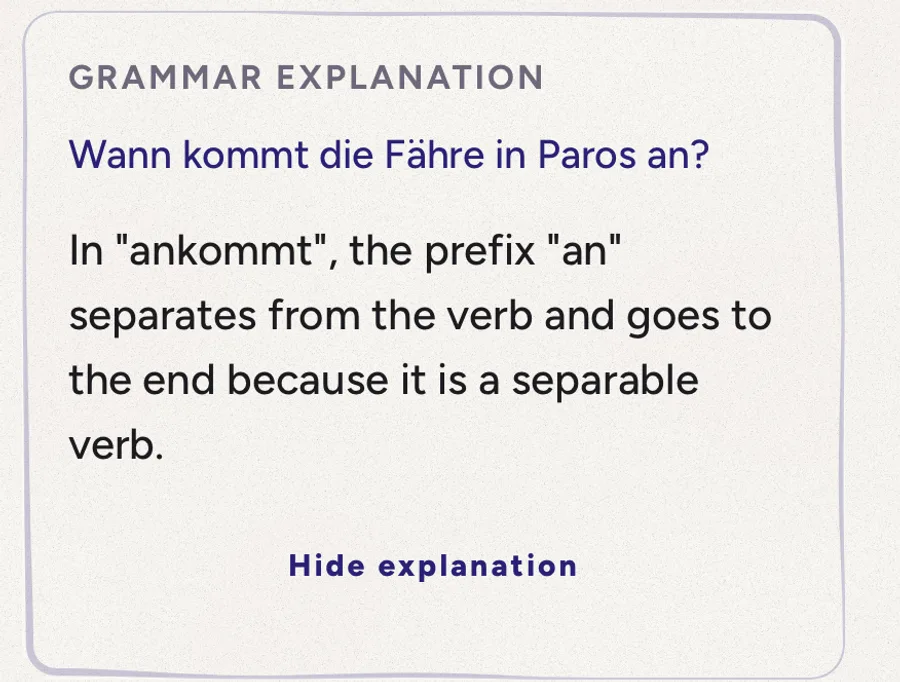
German puts verbs in places English doesn't. In a main clause the conjugated verb comes second, so after jetzt (now) you say jetzt gehe ich nach Hause (now go I home). Parts of the verb go to the end: ich habe ein Haus gebaut (I have a house built), and a separable verb splits in two: Fritz sieht das Bild an (Fritz looks at the picture, from ansehen). In a subordinate clause the conjugated verb moves to the very end: wenn ich nach Hause gehe (when I home go).
In a classic study, Jürgen Meisel, Harald Clahsen and Manfred Pienemann (1981) recorded conversations with 45 Italian and Spanish workers learning German in Germany without formal instruction. In their analysis of more than 40 adult learners, the rules appeared in a fixed order. Learners first sent verb parts and separable particles to the end, then learned to put the verb before the subject after words like jetzt, and only then sent the verb to the end of subordinate clauses. They found no one who had the last rule without the first two.
These learners spoke Romance languages and learned without classes, so their timing is not yours. The useful lesson is the order: if your weil clauses still come out in English order long after the rest feels easy, you are on a normal path.
Der, die, das: gender
Every German noun is masculine, feminine or neuter, and the article changes with it: der Löffel (the spoon), die Gabel (the fork), das Messer (the knife). There is often no reason you can see, so gender is learned one noun at a time.
Reading helps more than you might think. Denisa Bordag and colleagues (2019) had advanced learners of German read short texts containing new nouns. After as few as three to four encounters in context, the learners noticed when an article didn't match a new noun's gender, for feminine and neuter nouns. For masculine nouns, they did not, in that short a time. So read a lot, and give masculine nouns extra attention when you review.
Cases: who did what to whom
German marks a noun's role in the sentence with case endings, mostly on the articles. Der Hund beißt den Mann means "the dog bites the man". So does Den Mann beißt der Hund: the article den tells you the man is the one being bitten, even though he comes first.
English speakers tend to read the first noun as the subject, whatever its article says. Nick Henry (2022) looked for third and fourth semester university students of German, all native English speakers, who still misread these object-first sentences at least half the time, and enrolled 51 of them. Students taught with processing instruction, practice that makes you use the article to work out who did what, understood these sentences better afterward than students given a traditional explanation and exercises, and produced them just as well.
The takeaway: case is not learned by memorizing tables alone. You need plenty of practice where the endings carry the meaning.
What speeds it up
Intensive periods
In the Georgetown study, Norris and Pfeiffer compared students who had done the same first four semesters of coursework in one year, with six hours of class a week (intensive track), or in two years, with three (nonintensive). Most reached similar levels, but more of the intensive students reached Intermediate-High or above: 35 percent, against 15 percent. FSI's own experience points the same way. Jackson and Kaplan write that time on task and the intensity of the experience "appear crucial", and that the time needed to reach professional proficiency "cannot be shortened appreciably".
Spacing your reviews
Concentrated study time is not the same as cramming. Su Kyung Kim and Stuart Webb (2022) pooled 48 experiments with 3,411 participants and found that spaced practice had a medium to large effect on second language learning, and that longer gaps between sessions worked better on delayed tests. Study a lot when you can, but bring back each word and structure over days and weeks. We explain how in spaced repetition, and how to actually use it.
Lots of reading and listening
Jackson and Kaplan say FSI's experience shows "unequivocally" that the time learners spend reading, listening and interacting in the language is closely related to how well they can use it. For German, reading also feeds the slowest parts: gender and word order are learned from many examples. More in how to learn a language by reading.
A realistic plan
- Pick a goal you can describe. "Pass Goethe B1" or "talk with my in-laws for an evening" is better than "be fluent".
- Count hours, not months. A simple log turns "I'm not progressing" into "I've done 120 hours", which is honest and motivating.
- Find a daily minimum you will keep. Thirty minutes every day adds up to over 180 hours a year.
- Add intensive bursts. A summer course or a month of extra evenings will move you more than the same time spread thin.
- Learn every noun with its article. Write and say die Gabel, never just Gabel, and review masculine nouns a little more often.
- Read and listen a lot at your level. Word order and gender come from thousands of examples.
- Practice where case matters. Read and answer questions about sentences where only the article tells you who did what.
Where Franzie fits in
Franzie is one way to make those hours easier to keep. It writes stories in German at your level about topics you choose, so daily reading feels like reading, not homework. When a sentence puzzles you, tap for a grammar explanation of that very sentence, for example why the verb ended up at the end. You can tap any word for its meaning and forms, save it for review, and use the new words in a short roleplay after each chapter. It is a way to log steady hours, not a shortcut around them.
FAQ
How long does it take to learn German fluently?
For a professional level, the Foreign Service Institute's 2001 table expects 575 to 600 class hours plus daily homework, about 950 hours in total, from very able full time students. Most learners need longer, and most do not need that level to use German comfortably.
Is German harder than Spanish for English speakers?
In FSI's scores after 24 weeks, German and Spanish scored the same (2.25). German's vocabulary is closer to English; its grammar, with gender, cases and verb placement, takes longer to master.
Can you learn German in 6 months?
FSI's full time students reach a professional level in 23 to 24 weeks, with at least seven hours of class and study a day. With a normal schedule, six months gives you a solid base for simple conversations.
How long does it take to reach B1 in German?
There is no research-based number for each CEFR level, and course providers' estimates vary. As a guide, college students in one German program typically reached Intermediate-Mid on the ACTFL speaking scale after one to two years of classes three hours a week.
What is the hardest part of German?
For English speakers, usually gender, case endings and word order. Studies show learners pick up word order in a fixed sequence, and that many read past case endings until practice makes them rely on them.
Sources
- Bordag, D., Kirschenbaum, A., Rogahn, M., Opitz, A., & Tschirner, E. (2019). Misbehaved masculines: Incidental acquisition of grammatical gender in L2 German during reading. Bilingualism: Language and Cognition, 22(1), 130 to 141. https://doi.org/10.1017/S1366728917000608
- Chiswick, B. R., & Miller, P. W. (2005). Linguistic distance: A quantitative measure of the distance between English and other languages. Journal of Multilingual and Multicultural Development, 26(1), 1 to 11. https://doi.org/10.1080/14790710508668395
- Henry, N. (2022). The offline and online effects of processing instruction. Applied Psycholinguistics, 43(4), 945 to 971. https://doi.org/10.1017/S0142716422000200
- Jackson, F. H., & Kaplan, M. A. (2001). Lessons learned from fifty years of theory and practice in government language teaching. In J. E. Alatis & A.-H. Tan (Eds.), Georgetown University Round Table on Languages and Linguistics 1999 (pp. 71 to 87). Georgetown University Press.
- Kim, S. K., & Webb, S. (2022). The effects of spaced practice on second language learning: A meta-analysis. Language Learning, 72(1), 269 to 319. https://doi.org/10.1111/lang.12479
- Meisel, J. M., Clahsen, H., & Pienemann, M. (1981). On determining developmental stages in natural second language acquisition. Studies in Second Language Acquisition, 3(2), 109 to 135. https://doi.org/10.1017/S0272263100004137
- Norris, J. M., & Pfeiffer, P. C. (2003). Exploring the uses and usefulness of ACTFL oral proficiency ratings and standards in college foreign language departments. Foreign Language Annals, 36(4), 572 to 581. https://doi.org/10.1111/j.1944-9720.2003.tb02147.x
Keep reading
-
 Guides
How Long Does It Take to Learn French? What the Research Says
About 600 class hours for full time diplomats, and longer for most of us. What the FSI figures say about French, why listening is the slow part, and what helps.
Read the article
-
 Guides
How Long Does It Take to Learn Spanish? What the Research Says
About 600 class hours for diplomats training full time, and longer for most of us. What the FSI figures mean, why estimates vary and what speeds you up.
Read the article
-
 Memory
How Many Times Do You Need to See a Word to Learn It?
Research says about 10 encounters for a solid start, and some words take more than 20. Why the number varies, and how to make each encounter count.
Read the article