Spaced Repetition: The Science, and How to Actually Use It
Spaced repetition works: reviewing words at growing intervals beats cramming in study after study. What the research says, and how to use it without burning out.
In short: Spaced repetition means reviewing what you learn in several short sessions spread over days and weeks, instead of all at once. It is one of the best supported findings in memory research, and it works for vocabulary in a new language too. It works best when each review makes you recall the word (not just look at it), when the gaps grow as you remember better, and when the words also show up in what you read. Keep reviews short and daily, and you will remember far more for the same time.
What spaced repetition is
You learn a new word today, and by next week it is gone. That is normal. Memory fades fast at first and then more slowly, and the way to fight it is not to study harder once, but to come back to the word at the right moments.
Spaced repetition is a way to schedule those moments. You review a word soon after you learn it, then again after a longer gap, then a longer one still. Each time you remember it, the next review moves further away. Words you know well come back rarely; words you keep forgetting come back often. Flashcard apps do this scheduling for you, but you can also do it with paper cards and a calendar.
It rests on two findings from memory research:
- The spacing effect: the same amount of study is remembered better when it is spread out than when it is crammed together.
- The testing effect (also called retrieval practice): trying to recall something strengthens memory more than reading it again.
Spaced repetition puts the two together: recall, spread out over time.
The forgetting curve: where it started
The German psychologist Hermann Ebbinghaus was the first to measure forgetting. In the 1880s he memorized lists of 13 nonsense syllables (meaningless combinations of letters, so that meaning would not help him) and timed how long it took to relearn them later. The time he saved on relearning showed how much was still in memory. After about 20 minutes he saved 58 percent of the original learning time; after a day, about 34 percent; after a month, about 21 percent. Most of the loss happened in the first hours.
In 2015, Jaap Murre and Joeri Dros repeated the experiment. One participant spent 70 hours learning lists of syllables and relearning them after intervals from 20 minutes to 31 days. The curve came out very similar to the original one, more than 130 years later.
Ebbinghaus also noticed the spacing effect. In one of his experiments, 38 repetitions spread over three days prepared him as well for relearning a list as 68 repetitions made in a single day. Fewer repetitions, better spaced, did the same job.
The evidence: how strong is it?
Very strong. Spacing has been tested in hundreds of experiments over more than a century.
- A large review of spacing. Cepeda and colleagues (2006) gathered 839 measurements of spaced versus massed practice from 317 experiments in 184 articles. Spacing helped memory, and they found a pattern that matters for you: the longer you want to remember something, the longer the best gap between study sessions.
- The gap and the test. In a follow up study, Cepeda and colleagues (2008) taught more than 1,350 people a set of obscure facts, gave them a review after a gap of up to 3.5 months, and tested them up to a year later. The best gap was about 20 to 40 percent of the time until the test when the test came a week later, and about 5 to 10 percent when it came a year later. For the one year test, the best of the gaps they tried was about three weeks. Gaps that were too long cost much less than gaps that were too short.
- Foreign language words, over years. In a nine year study, Bahrick and colleagues (1993) had four participants learn 300 English and foreign language word pairs and relearn them over sessions 14, 28 or 56 days apart, then tested them up to five years later. Thirteen sessions 56 days apart gave about the same long term memory as 26 sessions 14 days apart: half the sessions, the same result.
- Second language learning in general. Kim and Webb (2022) pooled 98 results from 48 experiments with 3,411 language learners. Spaced practice had a medium to large effect on learning. Short gaps did as well as long ones on tests right after the study, but long gaps won on delayed tests, which are the ones that matter if you want to keep the language.
In a review of ten popular study techniques, Dunlosky and colleagues (2013) gave only two their highest rating, "high utility": distributed practice (spacing) and practice testing (recall). Rereading and highlighting got low ratings.
How sure are we? Very sure that spacing works. It has held up across ages, materials and decades, including for foreign language vocabulary. What is less certain is the exact best schedule, which depends on how long you want to remember and on the learner.
Recall, not reread: the other half
Spacing tells you when to review. The testing effect tells you how: by trying to remember, not by looking again.
- Roediger and Karpicke (2006) had students read short prose passages, then either reread them or write down what they remembered. On a test five minutes later, rereading did better. On tests two days and a week later, the students who had practiced recalling remembered much more, even though rereading had made students feel more confident.
- Rowland (2014) pooled 159 results from 61 studies comparing testing with restudying. Testing won, with an average effect of about half a standard deviation (g = 0.50). Tests where you had to recall the answer helped more than tests where you only had to recognize it among options.
This study is the most useful for flashcard users. Karpicke and Roediger (2008) had college students learn 40 Swahili and English word pairs (like mashua, boat). Once a student recalled a word correctly, it was either kept in practice or dropped. A week later, students who kept being tested on every word recalled about 80 percent of them. Students whose learned words were dropped from testing recalled just 36 and 33 percent, even when they kept studying them. All groups had predicted they would remember about half.
So a card you "know" is not finished. One correct answer is the start of learning a word, not the end. And for the same reason, a card that asks you to produce the word (see counter and say el mostrador) is worth more than one that only asks you to recognize it.
Fixed or growing gaps? Where the research disagrees
Most apps make the gaps grow: a day, a few days, a week, a month. This is called expanding spacing, and it feels logical. The evidence is mixed.
- Karpicke and Bauernschmidt (2011) compared expanding, equal and shrinking schedules of three recall tests. The total amount of spacing mattered a great deal: long gaps between tests gave a 200 percent improvement in long term memory over no gaps at all. But no schedule shape beat the others.
- Nakata (2015) had 128 Japanese college students learn 20 English words and found a small but real advantage for expanding gaps, and a much larger effect of simply spacing at all.
- In Kim and Webb's (2022) meta-analysis of language learning studies, equal and expanding spacing came out statistically the same.
The practical takeaway: the amount of spacing matters more than its exact shape. Growing gaps are still sensible, because a word you know well does not need to come back every week, and that saves you time. But don't worry about the perfect algorithm. Any schedule that spreads reviews over weeks beats one that doesn't.
Why most people review too much, or quit
Spaced repetition fails for two common reasons, and both come from how learning feels.
Cramming feels better than it is. Kornell (2009) had people learn word pairs with flashcards, either in one large stack (more spacing between repeats of each card) or in four small stacks studied one at a time (less spacing). The large stack worked better for 90 percent of the participants, yet after the first session 72 percent believed the small stacks had worked better. Massed practice gives you a quick feeling of mastery. It does not last.
Extra drilling in one session buys little. Rohrer and colleagues (2005) had 218 college students learn geography facts or word definitions, some just to the point of one correct recall and some with extra practice in the same session. A week later, the extra practice group remembered far more. After that, the difference shrank sharply. Going over the same cards again and again on the same day mostly helps tomorrow, not next month.
The flip side is that spaced, recall based reviews feel harder. You forget, you hesitate, you get things wrong. That difficulty is part of why they work, but it is also why people give up. Add to that a growing pile of due cards (too many new words added too fast, a few missed days) and it is easy to end up with 300 reviews waiting and no wish to start.
Flashcards plus reading: let words come back in context
Flashcards on their own are useful but limited. A meta-analysis by Webb, Yanagisawa and Uchihara (2020) looked at 22 studies of word focused activities (flashcards, word lists, writing and fill in the blanks). On average, learners recalled the meaning of 60.1 percent of the target words right after the activity, but only 39.4 percent on delayed tests. For producing the word, the delayed figure was 25.1 percent. The authors' conclusion: learning from such tasks "is far from guaranteed".
A flashcard also teaches only part of a word. It gives you mostrador = counter, but not how it is used, which words it goes with, or what it feels like in a sentence: Detrás del mostrador hay una carta. That part comes from meeting the word in real language.
Reading is a natural second engine of repetition. A meta-analysis by Uchihara, Webb and Yanagisawa (2019), pooling 26 studies with 1,918 learners, found that the more often learners met a word while reading or listening, the more likely they were to learn it (a medium sized relationship, r = .34), and spaced encounters were one of the factors that changed how strong that link was. If you want the details, our post on how to learn a language by reading covers how much of a text you need to understand.
The best combination: pick up words while reading, review them with spaced recall, and keep reading at your level so they come back in new sentences. The cards keep the words from fading; the reading makes them real.
How to use spaced repetition: a practical plan
- Save words from what you read or hear, not from random lists. Words you have met in a story come with a context you already know.
- Make cards that ask you to recall. Show the meaning in your language and produce the word in the new one. Include the article and the accents, and add an example sentence on the back.
- Review a little every day. Ten to fifteen minutes is a good place to start. Short daily sessions spread the work naturally.
- Limit new words. If your daily reviews take too long, stop adding cards for a few days. A small pile you finish beats a big one you avoid.
- Let the gaps grow, from a day to a few days to weeks and months. Any reasonable app does this; with paper cards, use boxes for "tomorrow", "this week" and "this month".
- Don't drop a word after one correct answer, and don't drill it ten times in a row either. Once per session is enough; let time do the rest.
- Keep reading. Every time a reviewed word shows up in a story, it counts as one more spaced encounter, in context.
Where Franzie fits in
We built Franzie so that this combination happens without extra effort. You read stories written at your level and tap any word to see what it means, its grammar and how it sounds, then save it with one tap.
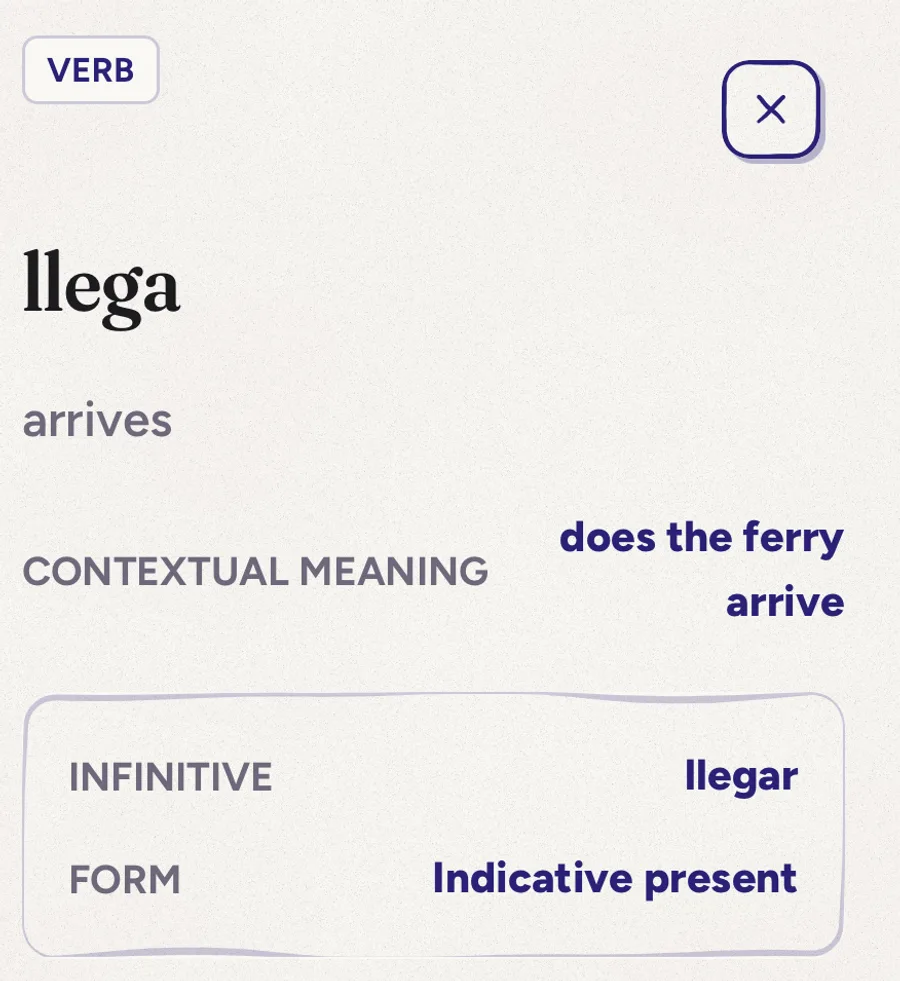
Saved words come back in your vocabulary reviews, where you see the meaning and type the word, with hints if you need them. Each correct answer pushes the next review further away, from a day up to about two and a half months; a mistake brings the word back sooner without starting it over from zero. Words you saved also come back in your next stories where they fit, so you meet them again in context, not just on a card.
You don't need an app to do this well, though. Paper cards, a notebook and a pile of graded readers follow the same principles: recall, spaced out, and plenty of reading.
FAQ
Does spaced repetition really work for learning a language?
Yes. It is one of the most consistent findings in memory research, and a meta-analysis of 48 experiments with language learners found a medium to large effect. It works best for vocabulary; for speaking and listening you also need practice in those skills.
How often should I review with spaced repetition?
Review new words the next day, then after a few days, then after a week or more, letting the gap grow each time you remember. Research suggests the exact schedule matters less than spreading reviews out at all.
How many new flashcards should I add per day?
There is no research based number. Add only as many as keep your daily reviews to a time you can sustain, often 10 to 15 minutes. If reviews pile up, pause new cards.
Is Anki better than other spaced repetition apps?
Studies support the principles (spacing and recall), not a specific app. Any tool that makes you recall the word and spreads reviews over weeks follows the research.
Can spaced repetition replace reading or speaking?
No. Flashcards help you keep words, but you learn how words are used by meeting them in real language. Combine reviews with reading at your level and using the words yourself.
Sources
- Bahrick, H. P., Bahrick, L. E., Bahrick, A. S., & Bahrick, P. E. (1993). Maintenance of foreign language vocabulary and the spacing effect. Psychological Science, 4(5), 316 to 321. https://doi.org/10.1111/j.1467-9280.1993.tb00571.x
- Cepeda, N. J., Pashler, H., Vul, E., Wixted, J. T., & Rohrer, D. (2006). Distributed practice in verbal recall tasks: A review and quantitative synthesis. Psychological Bulletin, 132(3), 354 to 380. https://doi.org/10.1037/0033-2909.132.3.354
- Cepeda, N. J., Vul, E., Rohrer, D., Wixted, J. T., & Pashler, H. (2008). Spacing effects in learning: A temporal ridgeline of optimal retention. Psychological Science, 19(11), 1095 to 1102. https://doi.org/10.1111/j.1467-9280.2008.02209.x
- Dunlosky, J., Rawson, K. A., Marsh, E. J., Nathan, M. J., & Willingham, D. T. (2013). Improving students' learning with effective learning techniques: Promising directions from cognitive and educational psychology. Psychological Science in the Public Interest, 14(1), 4 to 58. https://doi.org/10.1177/1529100612453266
- Ebbinghaus, H. (1913). Memory: A Contribution to Experimental Psychology (H. A. Ruger & C. E. Bussenius, Trans.). Teachers College, Columbia University. (Original work published 1885.) https://psychclassics.yorku.ca/Ebbinghaus/index.htm
- Karpicke, J. D., & Bauernschmidt, A. (2011). Spaced retrieval: Absolute spacing enhances learning regardless of relative spacing. Journal of Experimental Psychology: Learning, Memory, and Cognition, 37(5), 1250 to
- Karpicke, J. D., & Roediger, H. L. (2008). The critical importance of retrieval for learning. Science, 319(5865), 966 to 968. https://doi.org/10.1126/science.1152408
- Kim, S. K., & Webb, S. (2022). The effects of spaced practice on second language learning: A meta-analysis. Language Learning, 72(1), 269 to
- Kornell, N. (2009). Optimising learning using flashcards: Spacing is more effective than cramming. Applied Cognitive Psychology, 23(9), 1297 to
- Murre, J. M. J., & Dros, J. (2015). Replication and analysis of Ebbinghaus' forgetting curve. PLOS ONE, 10(7), e0120644. https://doi.org/10.1371/journal.pone.0120644
- Nakata, T. (2015). Effects of expanding and equal spacing on second language vocabulary learning: Does gradually increasing spacing increase vocabulary learning? Studies in Second Language Acquisition, 37(4), 677 to 711. https://doi.org/10.1017/S0272263114000825
- Roediger, H. L., & Karpicke, J. D. (2006). Test-enhanced learning: Taking memory tests improves long-term retention. Psychological Science, 17(3), 249 to 255. https://doi.org/10.1111/j.1467-9280.2006.01693.x
- Rohrer, D., Taylor, K., Pashler, H., Wixted, J. T., & Cepeda, N. J. (2005). The effect of overlearning on long-term retention. Applied Cognitive Psychology, 19(3), 361 to 374. https://doi.org/10.1002/acp.1083
- Rowland, C. A. (2014). The effect of testing versus restudy on retention: A meta-analytic review of the testing effect. Psychological Bulletin, 140(6), 1432 to 1463. https://doi.org/10.1037/a0037559
- Uchihara, T., Webb, S., & Yanagisawa, A. (2019). The effects of repetition on incidental vocabulary learning: A meta-analysis of correlational studies. Language Learning, 69(3), 559 to 599. https://doi.org/10.1111/lang.12343
- Webb, S., Yanagisawa, A., & Uchihara, T. (2020). How effective are intentional vocabulary-learning activities? A meta-analysis. The Modern Language Journal, 104(4), 715 to 738. https://doi.org/10.1111/modl.12671
Keep reading
-
 Memory
How Many Times Do You Need to See a Word to Learn It?
Research says about 10 encounters for a solid start, and some words take more than 20. Why the number varies, and how to make each encounter count.
Read the article
-
 Guides
How Long Does It Take to Learn French? What the Research Says
About 600 class hours for full time diplomats, and longer for most of us. What the FSI figures say about French, why listening is the slow part, and what helps.
Read the article
-
 Guides
How Long Does It Take to Learn German? What the Research Says
About 600 class hours for full time diplomats, and longer for most of us. What the FSI figures say about German, where the time goes, and what speeds you up.
Read the article