How Long Does It Take to Learn Italian? What the Research Says
About 600 class hours for full time diplomats, and longer for most of us. What the FSI figures say about Italian, CILS and CELI levels, and what helps.
In short: In the table the US Foreign Service Institute published in 2001, Italian is one of the easier languages for English speakers: 23 to 24 weeks, or 575 to 600 class hours, to reach a professional level. Those students study full time, add hours of homework a day and are chosen for their gift for languages. Counting the homework, plan on roughly 950 hours of focused work for a high level: about five years at 30 minutes a day, a bit over one at two hours a day. If you already speak Spanish, Portuguese or another Romance language well, you start with a real head start.
The short answer, and why you see different numbers
Search this question and you will find everything from "three months" to "it depends". The one number with decades of records behind it comes from the Foreign Service Institute (FSI), the school that trains US diplomats.
Two of its staff, Frederick Jackson and Marsha Kaplan, published the school's learning expectations in 2001. In their table, Italian is in Category I, the languages "closely cognate with English", together with French, German, Portuguese, Romanian, Spanish, Swedish, Dutch, Norwegian and Afrikaans. For these languages FSI expects students to reach its goal in 23 to 24 weeks, or 575 to 600 class hours. Category II languages, such as Greek, Polish or Turkish, take 44 weeks, and Category III (Arabic, Chinese, Japanese and Korean) 88 weeks.
Before you plan around 600 hours, look at who those hours describe:
- The goal is high. FSI aims for "general professional proficiency" in speaking and reading, including listening in conversation. Jackson and Kaplan say it is roughly equal to "superior" on the scale of the American Council on the Teaching of Foreign Languages, the top of the scale most US schools use.
- The hours are only class hours. FSI says learning quickly takes at least four class hours a day, five days a week, plus three or more hours a day of independent study.
- The students are unusual. The table assumes a native English speaker with "very good or better aptitude" for classroom language learning, and notes that less skilled learners typically take longer. FSI's students are adults (their mean age was 41) who already knew, on average, 2.3 other languages.
So 600 hours is not how long Italian takes. It is how long Italian takes for gifted, experienced learners studying full time, before you count their homework.
Is Italian easier than Spanish?
FSI's records give a more detailed answer than its categories do. The economists Barry Chiswick and Paul Miller (2005) used FSI scores of English-speaking Americans of average ability, measured after 24 weeks of training, to build a scale of how hard each language is to learn. On that scale, 1.00 is the hardest (Japanese) and 3.00 the easiest (Afrikaans, Norwegian and Swedish).
Italian scored 2.50, the same as French and Portuguese. Spanish and German scored 2.25. In other words, after the same 24 weeks, average learners of Italian scored a little higher than learners of Spanish. Both are among the easiest languages an English speaker can choose.
Part of the head start is vocabulary. English took thousands of words from Latin and French, so many Italian words look familiar: importante, possibile, la famiglia, la stazione, il problema. Words like these pay off twice. In an experiment with experienced language learners, Annette de Groot and Rineke Keijzer (2000) found that words resembling a word the learners already knew (cognates) were easier to learn and less likely to be forgotten a week later than words with no such resemblance. Italian spelling helps too: it is far more regular than English, so once you know the rules you can read most words aloud.
How sure are we? The FSI figures are real records from decades of teaching, which is rare and valuable. But they describe one group of learners in one kind of program, and the scale is coarse. Use them to compare languages, not as a promise for your own timeline.
Doing the math for a normal schedule
You can turn the FSI figures into a rough personal estimate, as long as you remember who they describe. Over 24 weeks, three hours a day of independent study, five days a week, adds about 360 hours to the 575 to 600 class hours. That makes roughly 950 hours of focused work to reach a professional level under ideal conditions.
| Daily study, every day | Time to about 950 hours |
|---|---|
| 30 minutes | about 5 years and 2 months |
| 1 hour | about 2 years and 7 months |
| 2 hours | about 1 year and 4 months |
Two honest adjustments:
- Most of us are not FSI students. No hand-picked aptitude, no class of six with a trained teacher. Expect to need more than this, not less.
- Most of us do not need FSI's goal. Ordering at a bar, chatting with your host family, finding your way around Rome and reading easy books come long before professional meetings. If that is your goal, a fraction of these hours gets you there.
Jackson and Kaplan add a warning for anyone hoping to squeeze it all into a few weeks. In their experience, the time a beginner needs to reach professional proficiency "cannot be shortened appreciably". FSI tried, and it did not work.
If you already speak Spanish, Portuguese or French
The FSI table is written for native English speakers. If you speak another Romance language, Italian is a much shorter trip, and research shows how much you understand before you study it at all.
Charlotte Gooskens and her colleagues (2018) tested 1,833 young, educated Europeans aged 18 to 33 on spoken texts in closely related languages. Each listener heard a short recorded text at an intermediate level and filled in missing words, a task called a cloze test. Italian was one of the test languages for Spanish, Portuguese, Romanian and French listeners. These were the average scores:
| Listeners | Correct answers in Italian | With almost no exposure to Italian |
|---|---|---|
| Romanian | 57.7% | 47.2% |
| Portuguese | 49.4% | 44.1% |
| Spanish | 45.7% | 38.2% |
| French | 24.2% | 22.9% |
So a Spanish or Portuguese speaker who has never studied Italian already understands a good share of spoken Italian, and French speakers somewhat less. That is a real head start, but it is not fluency: even the best group missed more than 40 percent of the missing words.
Jackson and Kaplan add an important detail. At FSI, knowing a related language only gave a clear advantage once learners spoke it at a high level (level 3 on FSI's scale, the professional level). Below that, it did not seem to help, and in their experience with pairs like French and Italian or Spanish and Portuguese, a weak knowledge of one "may be an actual hindrance" in learning the other. If your school Spanish is shaky, expect to mix the two up for a while: burro is butter in Italian but a donkey in Spanish, and salire means to go up, not to leave.
Levels and exams: CILS, CELI and the CEFR
"How long" only makes sense once you say "to do what". In Europe, levels are described with the CEFR (Common European Framework of Reference for Languages): A1 and A2 for basic users, B1 and B2 for independent users, C1 and C2 for proficient users.
Italy's two best known certificates follow these levels:
- CILS, from the University for Foreigners of Siena, runs from A1 to C2. B1 is called CILS UNO, B2 DUE, C1 TRE and C2 QUATTRO.
- CELI, from the University for Foreigners of Perugia, is numbered as well: CELI 3, for example, is B2.
Universities, employers and some residence and citizenship applications ask for a certificate at a given level, often B1 or B2.
You will also see hour estimates for each level, from schools and course providers. They rarely agree, because they describe different courses with different students and different amounts of homework. We could not find research that pins down hours per level for Italian, so treat those charts as a rough guide, and expect the steps to get longer as you climb.
The part that takes longer: hearing double consonants
Italian is kind to beginners: regular spelling, clear vowels, lots of familiar words. One feature, though, catches English speakers out for a long time. Italian has double consonants (linguists call them geminates), held for longer than single ones, and the length changes the word: papa (pope) and pappa (baby food), fata (fairy) and fatta (made). English has nothing like it, so English speakers tend not to hear the difference.
Valentina De Iacovo, Angelo Dian and John Hajek (2025) tested this in Melbourne and Turin. They played words with consonants of different lengths to 15 native speakers in Italy, 20 heritage speakers in Australia (who grew up with Italian-speaking parents) and 20 Australian university students in an intermediate Italian course, and asked which word they heard. Native speakers relied clearly on how long the consonant lasted. The students showed "very little to no sensitivity" to the difference, even though some had studied Italian since primary school. The heritage speakers, with far more exposure over their lives, fell in between.
The lesson is not that you will never hear it. It is that classroom hours alone are not enough, and that exposure matters. The good news is that pronunciation responds to practice. Junkyu Lee, Juhyun Jang and Luke Plonsky (2015) pooled 86 studies of pronunciation instruction and found a generally large effect. Longer interventions, and those that gave learners feedback, worked better.
You don't need a perfect accent. Jackson and Kaplan note that native accent is typically not a practical criterion for success at FSI, "although intelligibility is". Aim to be understood easily, not to pass as Roman.
What speeds it up
Time and intensity
Jackson and Kaplan write that time on task and the intensity of the learning experience "appear crucial", and that FSI's experience shows "unequivocally" that time spent reading, listening and interacting in the language is closely related to how well learners can use it. A summer in Italy or a month of extra evenings moves you more than the same hours spread thin.
Spacing your reviews
Intensity is not the same as cramming. Su Kyung Kim and Stuart Webb (2022) pooled 48 experiments with 3,411 participants and found that spaced practice had a medium to large effect on second language learning, and that longer gaps between sessions worked better on delayed tests. Study a lot when you can, but bring back each word over days and weeks. We explain how in spaced repetition, and how to actually use it.
Reading, with sound
Reading is where English speakers make fast progress in Italian, because of all those familiar words (more in how to learn a language by reading). The trick is to hear what you read. Reading along with audio links the spelling to the sound, and in Italian the spelling tells you exactly where the double consonants are, so the page can train your ear.
A realistic plan
- Pick a goal you can describe. "Pass CILS UNO" or "talk with my in-laws in Naples" is better than "be fluent".
- Count hours, not months. A simple log turns "I'm not progressing" into "I've done 120 hours", which is honest and motivating.
- Find a daily minimum you will keep. Thirty minutes every day adds up to over 180 hours a year.
- Use what you know, carefully. Lean on familiar words, but check the ones that only look familiar, especially if you speak Spanish.
- Listen from day one. Short audio at your level, every day, trains your ear long before it feels easy.
- Read with audio. Follow the text while it is read aloud, and notice the double letters as you hear them.
- Practice the hard pairs on purpose. Fata and fatta, caro and carro, a few minutes at a time, with feedback if you can get it.
Where Franzie fits in
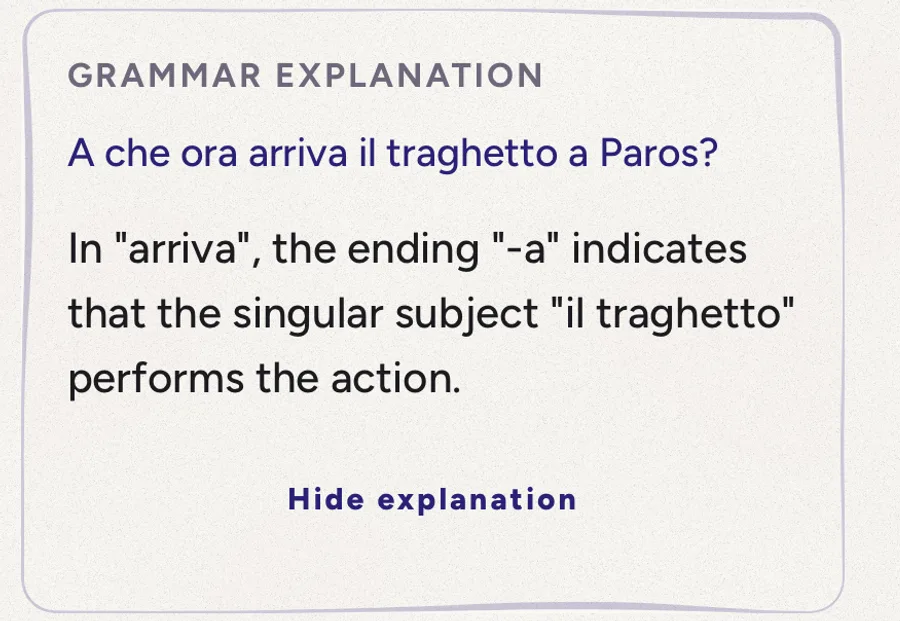
Franzie is one way to make those hours easier to keep. It writes stories in Italian at your level about topics you choose, and reads each chapter aloud, so you hear every line you read. You can tap any word for its meaning and forms, save it and review it later, and ask for a short grammar explanation of any sentence, like why a verb ends the way it does. A short roleplay after each chapter lets you use what you read. It is a way to log steady hours, not a shortcut around them.
FAQ
How long does it take to learn Italian fluently?
For a professional level, the Foreign Service Institute's 2001 table expects 575 to 600 class hours plus daily homework, about 950 hours in total, from very able full time students. Most learners need longer, and most do not need that level to use Italian comfortably.
Is Italian easier than Spanish for English speakers?
Slightly, by FSI's records. In scores for learners of average ability after 24 weeks, Italian scored 2.50 and Spanish 2.25, on a scale where higher means easier. Both are among the easiest languages for English speakers.
Can you learn Italian in 3 months?
Not to a high level. FSI's full time students need 23 to 24 weeks with at least seven hours of class and study a day. With a normal schedule, three months gives you a base for simple conversations and easy reading.
Is Italian easy if you speak Spanish?
Easier, yes. In one large study, Spanish speakers with almost no exposure to Italian filled in 38.2% of the missing words in a spoken Italian text. You still need to study it, and a weak knowledge of Spanish can cause mix-ups.
How long does it take to reach B1 in Italian?
There is no research-based number of hours for each CEFR level, and course providers' estimates vary. As a guide, B1 sits well below FSI's professional goal, so it takes a good deal fewer than its roughly 950 hours.
Sources
- Chiswick, B. R., & Miller, P. W. (2005). Linguistic distance: A quantitative measure of the distance between English and other languages. Journal of Multilingual and Multicultural Development, 26(1), 1 to 11. https://doi.org/10.1080/14790710508668395
- De Groot, A. M. B., & Keijzer, R. (2000). What is hard to learn is easy to forget: The roles of word concreteness, cognate status, and word frequency in foreign-language vocabulary learning and forgetting. Language Learning, 50(1), 1 to 56. https://doi.org/10.1111/0023-8333.00110
- De Iacovo, V., Dian, A., & Hajek, J. (2025). The perception of gemination in Italian by first-language speakers in Italy and heritage and second-language speakers in Australia. Phonetica, 82(5), 363 to 386. https://doi.org/10.1515/phon-2025-0012
- Gooskens, C., van Heuven, V. J., Golubović, J., Schüppert, A., Swarte, F., & Voigt, S. (2018). Mutual intelligibility between closely related languages in Europe. International Journal of Multilingualism, 15(2), 169 to 193. https://doi.org/10.1080/14790718.2017.1350185
- Jackson, F. H., & Kaplan, M. A. (2001). Lessons learned from fifty years of theory and practice in government language teaching. In J. E. Alatis & A.-H. Tan (Eds.), Georgetown University Round Table on Languages and Linguistics 1999 (pp. 71 to 87). Georgetown University Press.
- Kim, S. K., & Webb, S. (2022). The effects of spaced practice on second language learning: A meta-analysis. Language Learning, 72(1), 269 to 319. https://doi.org/10.1111/lang.12479
- Lee, J., Jang, J., & Plonsky, L. (2015). The effectiveness of second language pronunciation instruction: A meta-analysis. Applied Linguistics, 36(3), 345 to 366. https://doi.org/10.1093/applin/amu040
Keep reading
-
 Guides
How Long Does It Take to Learn French? What the Research Says
About 600 class hours for full time diplomats, and longer for most of us. What the FSI figures say about French, why listening is the slow part, and what helps.
Read the article
-
 Guides
How Long Does It Take to Learn German? What the Research Says
About 600 class hours for full time diplomats, and longer for most of us. What the FSI figures say about German, where the time goes, and what speeds you up.
Read the article
-
 Guides
How Long Does It Take to Learn Spanish? What the Research Says
About 600 class hours for diplomats training full time, and longer for most of us. What the FSI figures mean, why estimates vary and what speeds you up.
Read the article